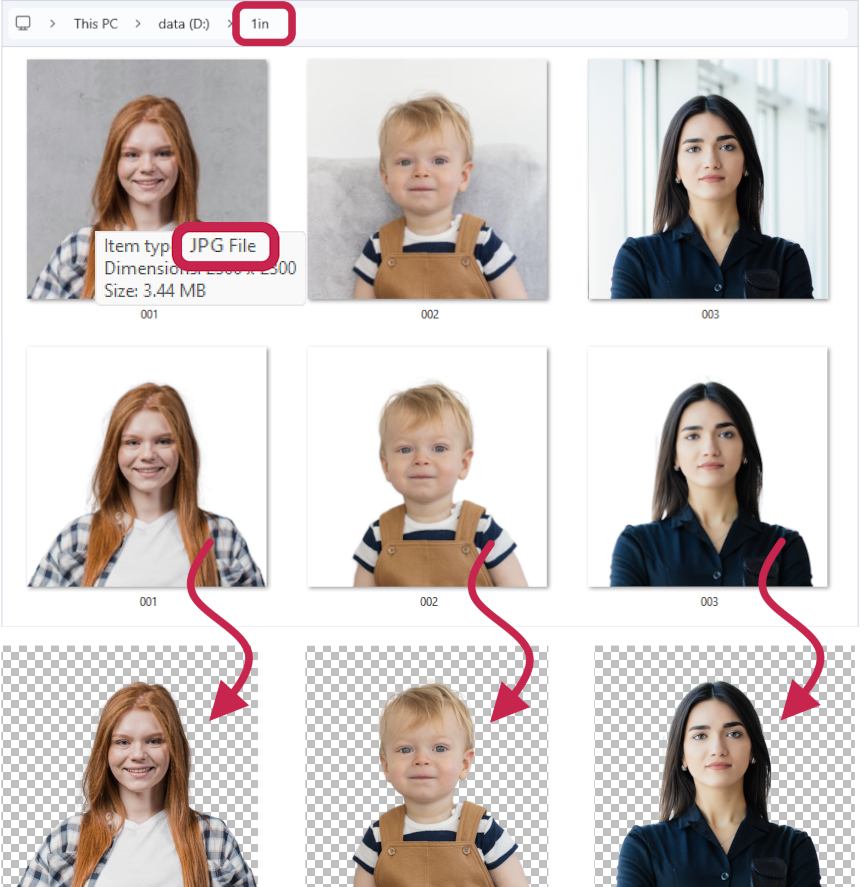
To create processed images with a transparent background, the application must save them in a format that supports transparency, such as PNG or TIFF.
By default, the application preserves the format of the source file for the processed image. If original file is already in PNG or TIFF format, no further adjustments to file format are needed to maintain transparency.
However, if source files is in a format like JPEG (JPG) that lacks transparency support, you will need to convert them to PNG or TIFF during processing. Use the --output-format key to make this change.
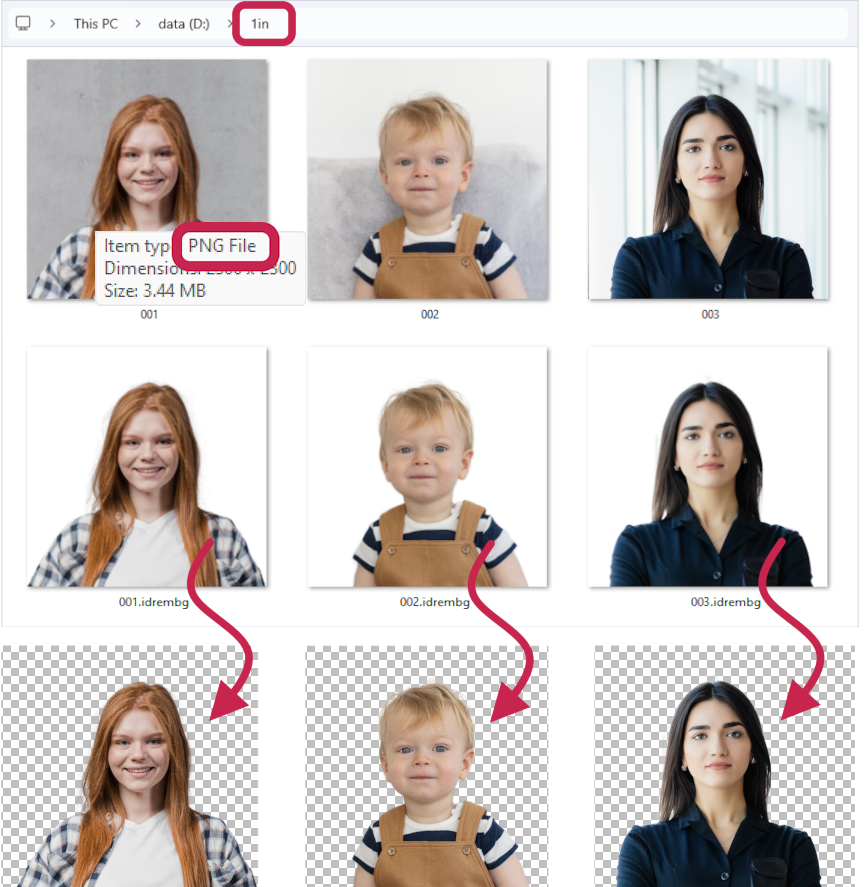
An example for a folder containing source files in PNG format:
The D:\1in folder contains images in PNG format: 001.png, 002.png, 003.png. Let's start processing the D:\1in folder and set a transparent background color using the -b key with the value transparent.
>idrembg --in-dir "D:\1in" -b transparent |
As a result, the following processed images will be created in the D:\1in folder: 001.idrembg.png, 002.idrembg.png, 003.idrembg.png with a completely transparent background.
An example for a folder containing source files in JPEG format:
The D:\1in folder contains images in JPEG format: 001.jpg, 002.jpg, 003.jpg. Let's process the original JPEG files and create a output PNG files with a transparent background.
The transparent background is set using the -b key with the value transparent.
The format in which the processed files should be created is set using the --output-format key with the value png.
>idrembg --in-dir "D:\1in" -b transparent --output-format png |
As a result, processed files in PNG format will be created in the D:\1in folder with source files in JPG format: 001.png, 002.png, 003.png with fully transparent background.